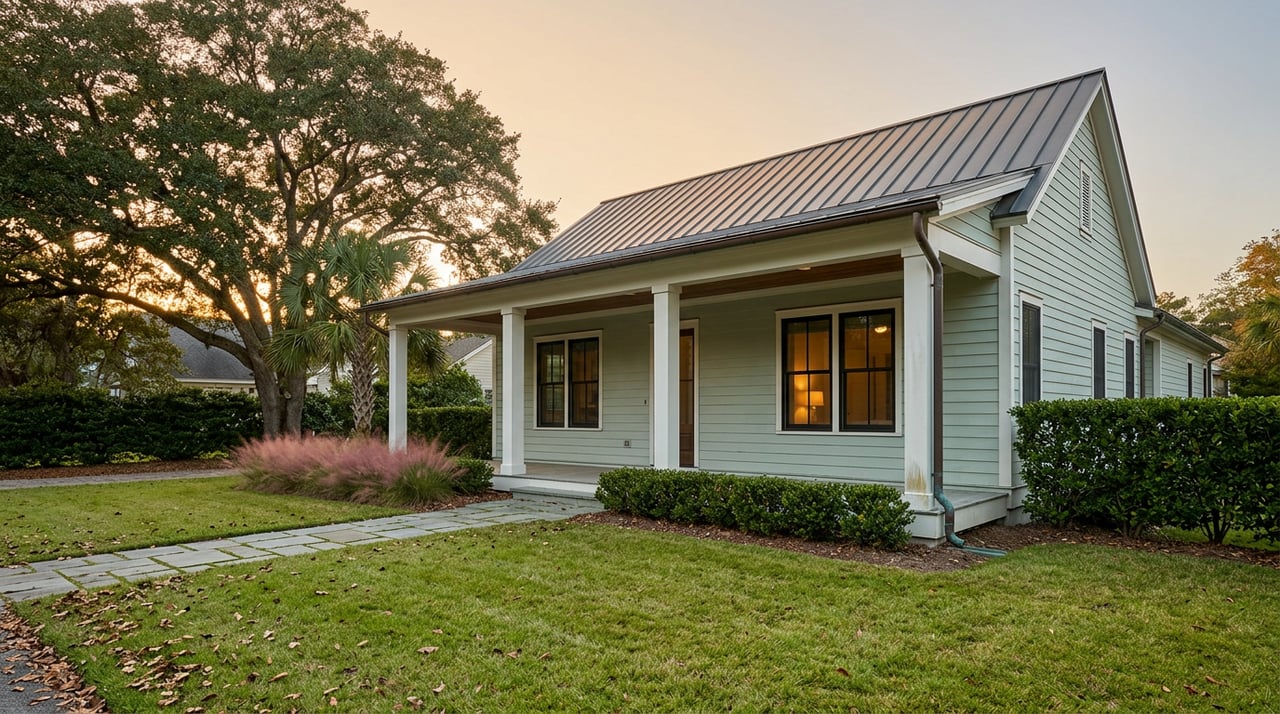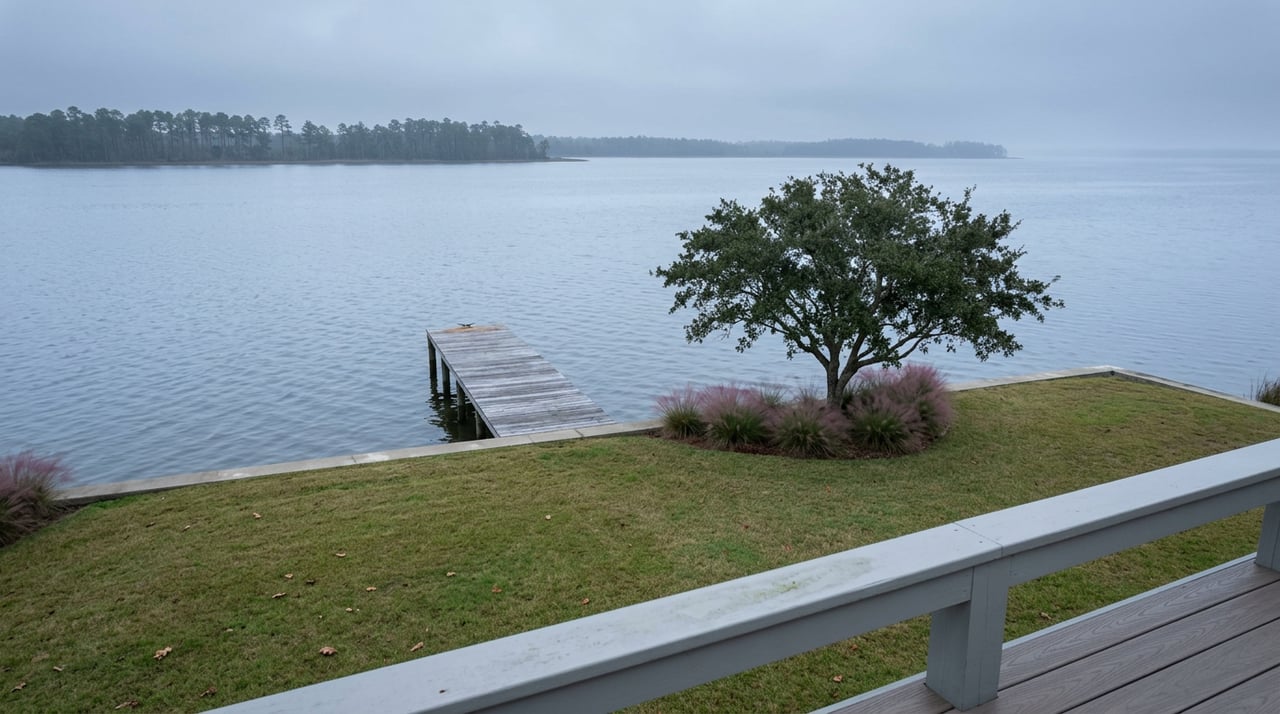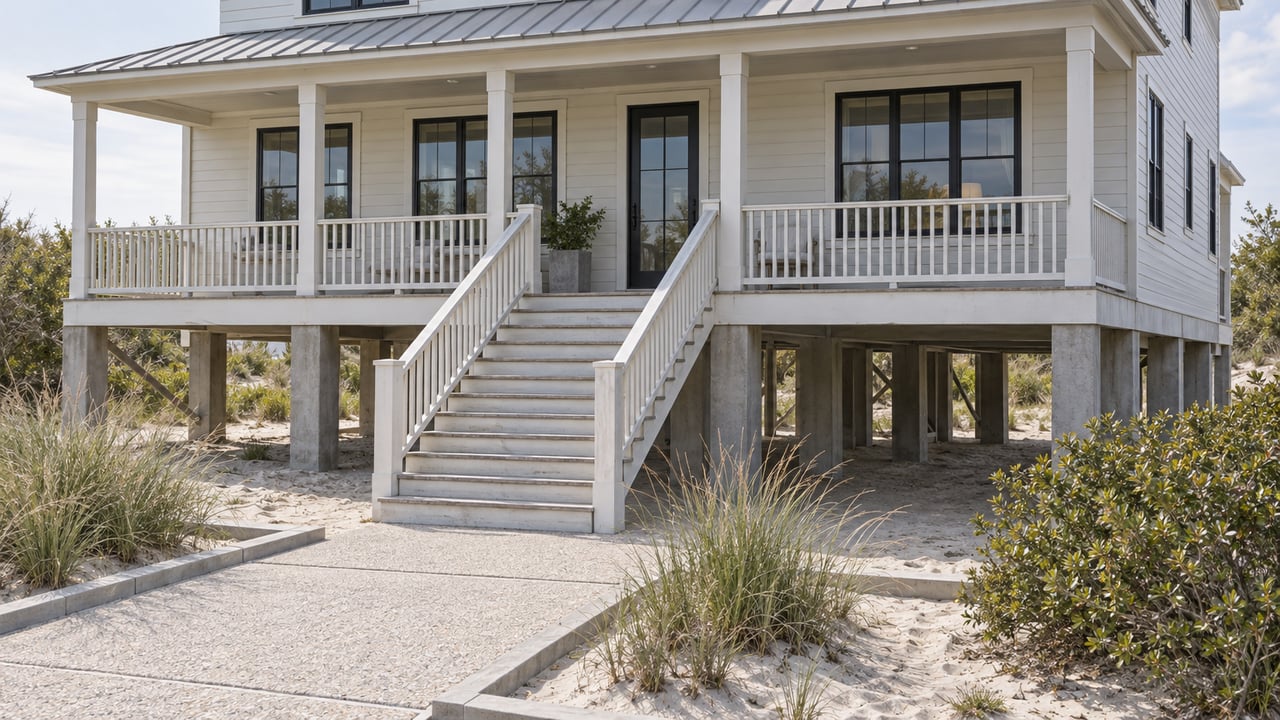
Drive south on Anderson Boulevard toward the point and the skyline flattens out. Elevated cottages, a scatter of mid-century beach houses, the old missile-tower remnants from the town's stint as a World War II proving ground. No towers. No stacked condo decks catching the sun. Then you cross into North Topsail Beach a few miles up the island and the buildings start climbing, unit after unit of vacation rental stock rising toward height limits measured in the mid-forties of feet.
Most buyers assume Topsail Beach just chose to stay small, the way a town might choose brick over vinyl. It didn't choose. It can't build the way its northern neighbor does, and the reason has almost nothing to do with a height ordinance. It comes down to two older, less visible facts: the town never built a central sewer system, and its 1972 zoning code drew a hard line around the oceanfront that multi-unit buildings still can't cross. Stack a state erosion formula on top of both, and you get a housing stock that looks nothing like the rest of the island, prices that swing wildly from one closed sale to the next, and a market where the published median tells you almost nothing about what you'd actually be buying.
The line drawn in 1972
Topsail Beach's original zoning ordinance split the town into four residential districts: Oceanfront, Soundfront, Canalfront, and Inside. Only the last three permit multi-unit buildings. The Oceanfront district was written for single-family homes and duplexes only, full stop, and the town's current land development code, available through Municode's public library, still organizes the town along that same map. Minimum lot sizes ran 5,000 square feet, with 2,500 square feet required per dwelling unit, on lots at least 50 feet wide.
There is exactly one visible exception, and it proves the rule rather than breaking it. A planning-era hazard document from the mid-1980s describes a roughly 120-unit development called Queens Grant going up on the ocean side of Anderson Boulevard, just south of Dolphin Pier, at a scale nothing else on that stretch has matched since. It stands today as the closest thing Topsail Beach has to a condo tower, and the fact that it's still the exception, decades later, tells you how tightly the oceanfront zoning has actually held.
No pipe under the street
Zoning only explains what's legally allowed. What actually gets built comes down to plumbing, and Topsail Beach has never operated a central sewage treatment plant. Planning records for the town describe individual septic systems serving properties throughout, with no municipal collection system taking their place. Compare that to North Topsail Beach a few miles north, where the Onslow Water and Sewer Authority runs a wastewater treatment plant currently being upgraded from 1.5 million gallons per day to 3.0 million gallons per day capacity, serving roughly 6,000 residential and commercial customers across North Topsail Beach and Sneads Ferry.
A municipal plant lets a town absorb density. A dozen condo units can tie into one line and one treatment facility. A septic system can't. Every lot's buildable footprint gets capped by what its soil can actually support for a drain field, which means adding bedrooms or square footage runs into a hard, physical ceiling long before it runs into a zoning variance. That ceiling exists whether or not the parcel sits in a district where multi-unit construction is technically legal. You can be zoned for four units and still only have enough usable soil for one house.
The setback stacks on top
North Carolina's Coastal Area Management Act adds a second constraint specific to oceanfront lots. The state's oceanfront setback line is measured from the first line of stable natural vegetation, and it requires that single-family homes, smaller buildings, and their septic systems sit back a distance equal to 30 times the shoreline's long-term annual erosion rate, with a 60-foot minimum regardless of how slow that erosion rate is.
If a stretch of shoreline erodes at 3 feet a year, the required setback comes out to 90 feet from the vegetation line, not 60.
That formula moves with new erosion-rate updates, and it shrinks the same lot from two directions at once: a septic system already limited by soil capacity now also loses depth to a setback measured off a shifting reference line. On an oceanfront district that already bans multi-unit construction, the combined effect is a housing stock that stays low, stays single-family, and rarely gets meaningfully bigger over time. That is the actual mechanism behind the town's look, not a preference for a particular architectural style.
What that does to the price tag
This is where the constraint stops being a planning curiosity and starts being a pricing problem for anyone comparing listings. Local brokerage data for the town shows waterfront single-family homes running as high as $3.5 million, while a beachfront condo, sitting mostly in the Soundfront, Canalfront, or Inside districts where multi-unit construction is permitted, can list for as little as the low $200,000s. One market tracker's March 2026 snapshot put the town's average condo price near $840,000 and its average single-family price near $1.6 million in the same window, a gap wide enough that a single "median home price" for Topsail Beach obscures more than it reveals.
The volume problem makes it worse. That same March 2026 snapshot recorded only five closed sales for the entire month, against 20 active listings and roughly four months of supply, with homes sitting a median 141 days on market and selling at about 95 percent of list price. A separate national home-value index put the town's average value closer to $966,000 as of late July 2026. Neither number is wrong. They're measuring a market so thin that one $3.5 million oceanfront closing and one $220,000 condo resale, landing in the same reporting window, can pull two different trackers' medians in opposite directions. In a town this size, the headline median is less a market signal and more a coin flip determined by which two or three properties happened to close.
Named subdivisions make the split easier to read on the ground. The Peninsula, Serenity Point, and Maritime Way sit in the districts where duplexes and multi-unit buildings are allowed, which is where the condo and townhome inventory clusters. Queens Grant remains the outlier oceanfront exception. If a listing's price looks unusually low for a Topsail Beach address, checking which residential district it falls in usually explains why before any inspection does.
What to verify before you write an offer
The mechanism above turns into specific due diligence items once you're looking at a real parcel:
- Confirm the residential zoning district (Oceanfront, Soundfront, Canalfront, or Inside) directly with the town, since it determines whether the lot could ever support anything beyond a single-family home or duplex.
- Ask for the septic system's permitted capacity and any soil evaluation on file, not just its pump-out history. Capacity, not condition, sets the real ceiling on additions or bedroom count.
- Pull the current CAMA oceanfront setback calculation for the specific lot rather than relying on a neighboring property's setback, since erosion-rate updates can move the line between sales.
- Request the flood zone designation and elevation certificate. The town's floodplain development permit application spells out what a lender or insurer will ask for before closing.
How the two towns actually compare
| Topsail Beach | North Topsail Beach | |
|---|---|---|
| Wastewater | Individual septic systems, no central plant | Municipal plant (ONWASA), expanding to 3.0 MGD |
| Oceanfront zoning | Single-family and duplex only | Condominiums permitted, height capped near 45 feet |
| Typical price band | Roughly $200K condos to $3.5M waterfront homes | Wider mix, more condo inventory |
| Housing character | Elevated cottages, low-rise, limited new supply | Newer construction, higher density |
None of this makes one town a better buy than the other. It makes them structurally different products, and the difference is durable. A septic system and a 1972 zoning line don't shift with a single town council vote or a strong sales year. Anyone comparing a Topsail Beach listing to something in North Topsail Beach or Surf City is comparing two different infrastructure realities, not two versions of the same beach house at two different price points.
The quiet, low-rise character that draws people to Topsail Beach in the first place is the direct output of the plumbing and the zoning map underneath it, and that's exactly why it has held for decades while the rest of the island kept building up.
If you're weighing a lot or a listing on Topsail Beach and want the septic capacity, the zoning district, and the current setback math pulled together before you make an offer, Ronel Austin can walk through it with you. Let's Connect.